
Key Points
· Disposable liners must match their compatible outer canisters. Matching capacity alone does not guarantee mechanical compatibility.
· Patient tubing, regulators, connectors, and protective components must work as one connected system.
· Mobile and fixed collection setups suit different clinical layouts and movement requirements.
· Buyers should verify package contents, cleaning instructions, technical documents, and replacement part supply before ordering.
Introduction
Hospital suction equipment collects blood, irrigation fluid, and other body fluids during surgery and patient care. Selecting a collection system involves more than checking container capacity. The liner must fit the outer canister, connections must match the available vacuum source, and the equipment must suit the clinical environment.
Suction liner system may be supplied as separate components or as a complete system. This affects installation, compatibility checks, and purchase costs. Understanding each component in advance can help buyers identify missing parts and avoid incompatible combinations.
What components does the suction liner system consist of?
One set of suction liner system contains several connected parts. Buyers should understand their functions before comparing configurations.
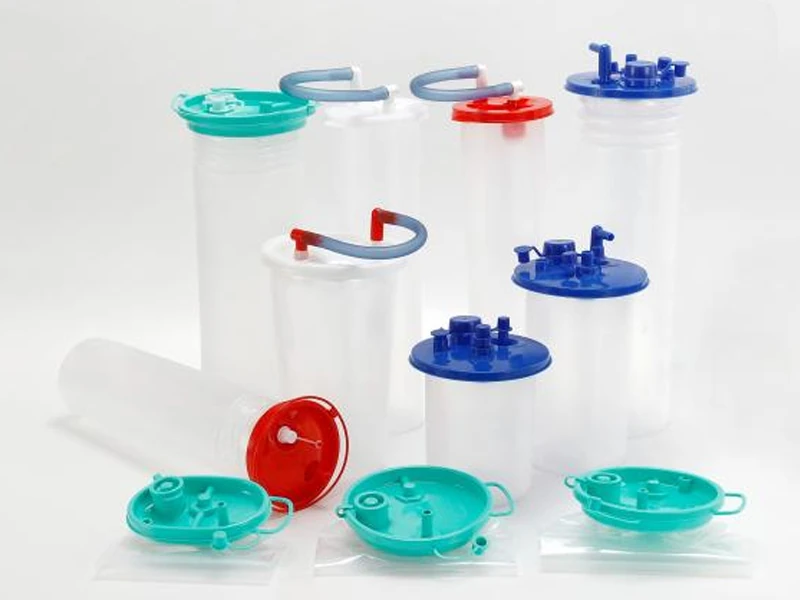
Disposable Suction Liner and Fluid Collection
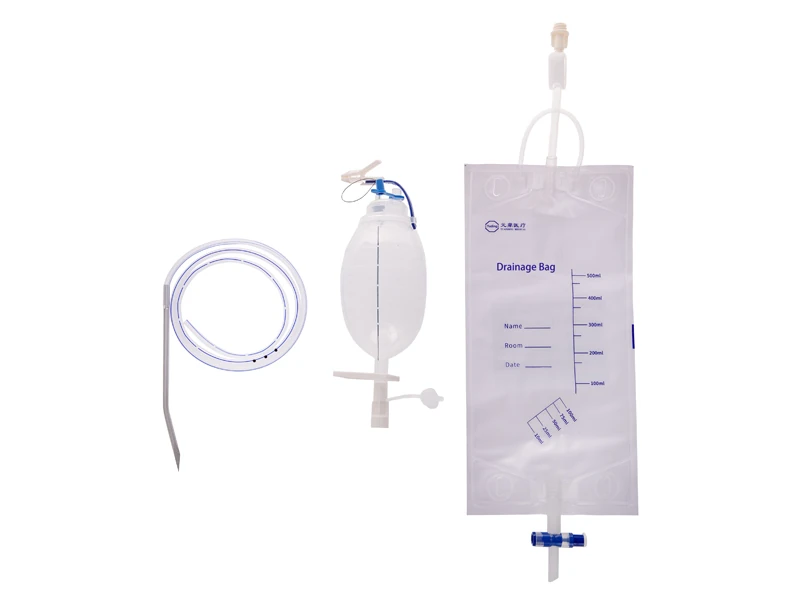
Disposable suction liners receive blood, irrigation fluid, and other liquids. It sits inside a rigid outer canister. When connected to a vacuum source, negative pressure draws fluid through the patient tubing and into the liner.
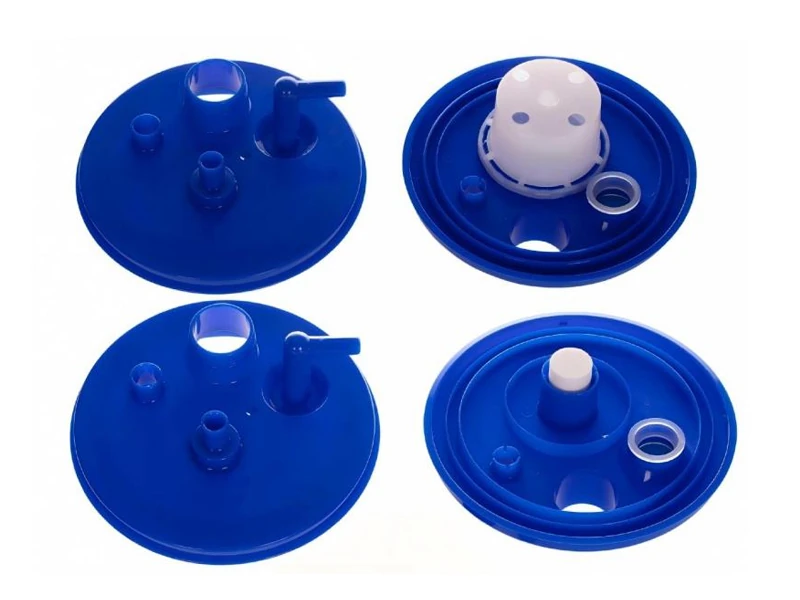
Compatibility depends on more than capacity. Different liners may have different lid dimensions, port positions, and sealing structures. A liner that fits one canister may not fit another.
Check the liner dimensions, lid design, port layout, and filter configuration. Confirm whether it includes a shut off mechanism and whether it is designed for single use. Filters and shut off mechanisms have different functions and should not be treated as interchangeable.
For existing installations, request a compatibility list identifying approved liner models for each canister. Similar appearance and capacity are not sufficient evidence of compatibility.
Reusable Canister and Mounting Components
A reusable suction canister holds the liner and connects the collection system to the vacuum source. Some models include graduations for observing collected fluid volume.
Check the internal dimensions, liner seating area, lid design, and vacuum port position. If the liner cannot sit securely or the lid cannot close properly, the combination should not be used merely because the capacity ratings match.
Mounting components also need to fit the installation. Wall brackets suit fixed collection points, while equipment rail mounts must match the rail design. Mobile stands are more suitable when staff need to reposition the equipment.
For existing installations, provide the supplier with mounting dimensions and equipment details. For new setups, confirm that the canister, bracket, and stand are designed to work together.
Reusable canisters also require defined cleaning, inspection, and storage procedures. These requirements should be confirmed before purchase.
Vacuum Tube, Regulators, and Protection Components
Vacuum tube connects the collection container to the medical vacuum source. A regulator controls suction within its specified operating range. Its pressure range and connection type depend on the model, so compatibility with the hospital outlet must be confirmed.
Filters, shut off mechanisms, and overflow safety bottles serve different purposes. A filter blocks liquid ingress while permitting gas flow under specified operating conditions. A shut off mechanism interrupts suction once its trigger threshold is reached. An overflow safety bottle provides an additional barrier before the vacuum line reaches downstream equipment.
Request a connection diagram showing the patient tubing, liner, canister, regulator, protective components, and vacuum adapter. Compare the outlet connection with the regulator and tubing specifications. If an adapter is required, include it in the quotation.
The supplier should also explain what happens when the liner reaches its filling limit. Identify the protective component, its position, and its inspection or replacement requirements. Do not assume a single filter or safety bottle can prevent all potential overflow scenarios.
How Should Buyers Evaluate The Suction Collection Configuration?
The main evaluation points are collection capacity, vacuum compatibility, and equipment mobility. Each affects whether the system suits its intended clinical location.
Match Liner Capacity with Expected Collection Volume
A larger liner is not automatically better. Capacity should reflect the expected collection volume, while the liner dimensions must remain compatible with the outer container.
Start with the clinical team’s estimate of the fluid volume expected during the intended procedure or care activity. Then check which liner models are approved for the selected canister.
Two liners with the same stated volume may have different lid diameters or port systems. One may not fit the existing container. Packaging capacity alone does not confirm mechanical compatibility.
A suitable combination must meet three conditions: sufficient capacity, secure liner placement, and manufacturer-confirmed compatibility. Request a model-by-model compatibility list when several sizes are available. The clinical team should confirm that the selected capacity suits the intended procedure.
Verify the Vacuum Connection and Overflow Protection
The collection path generally runs from the patient tubing to the liner and canister, then through protective components toward the vacuum source. The exact system depends on the equipment design.
Check each connection type. Compare the regulator and tubing connections with the hospital vacuum adapter. Confirm whether an adapter is needed, whether the tubing length suits the installation, and whether the connection direction is clearly marked.
Ask whether the system uses a filter, shut off mechanism, overflow safety bottle, or a combination of these components. Confirm where each part is installed and what inspection or replacement it requires.
A general statement such as “with overflow protection” is insufficient for technical approval. Request a connection diagram and written explanation of the protective path before ordering.
Choose a Mobile or Fixed Collection system
A fixed system suits a collection point beside a bed or at a designated workstation. Wall brackets or equipment rails can hold the canister in position, but this setup is less convenient when equipment must move between rooms.
A suction trolley is more suitable when staff need to reposition collection equipment within a clinical area. However, wheels alone do not establish that a trolley fits the facility.
Check the overall dimensions against doorways, corridors, and storage areas. Ask whether the casters have locking mechanisms and whether the stand remains stable when parked. Confirm that the canister and brackets fit the trolley frame.
A fixed mount is generally practical when the collection point rarely changes. A mobile system is preferable when equipment needs regular repositioning. Obtain dimensions and caster details rather than relying on product photographs.
What Should Buyers Verify Before Ordering?
A quotation should identify the components being supplied, not simply name the main equipment. Technical details and commercial terms must be reviewed together.
Confirm Compatibility and Complete Package Contents
Request a bill of materials or packing list identifying the stand, canister, bracket, regulator, safety bottle, tubing, connectors, and disposable liners where applicable. Mark each item as standard, optional, or separately purchased.
This distinction matters when comparing quotations. One supplier may quote only the stand and canister, while another includes the regulator and protective components. A lower price may therefore exclude parts needed for operation.
If the facility already has a vacuum adapter or equipment rail, provide the supplier with its specifications. Request written confirmation that the proposed connections and mounting parts are compatible.
Before approving the order, compare the quotation with the packing list. Check component models and quantities, identify missing adapters, and ensure the connection system has been reviewed by the relevant technical or clinical team.
Review Cleaning Instructions and Product Documentation
Disposable liners and reusable equipment have different handling requirements. Liners are discarded after use, while reusable canisters and trolley surfaces require cleaning and disinfection according to the manufacturer’s instructions.
The U.S. Centers for Disease Control and Prevention (CDC) advises healthcare facilities to follow manufacturer instructions when developing cleaning procedures for reusable equipment. Refer to the CDC’s Environmental Cleaning Procedures.
For a fluid management system powered by a vacuum or positive pressure gas source, ISO 10079 3:2022 specifies basic safety and performance requirements for suction equipment powered by medical vacuum or pressure gas sources, including devices connected to medical gas pipeline systems or gas cylinders.
Note that this standard applies to complete suction systems, and does not cover every individual component such as standalone liners, canisters, trolleys or accessories under its scope.
Request technical specifications, instructions for use, product labels, and relevant quality or regulatory documents. Check that the product name, model, manufacturer, and document scope match the equipment being purchased. Requirements may vary by intended use and destination market.
Compare Supply Terms and Replacement Support
Ask for separate prices for the trolley, reusable canisters, disposable liners, and optional accessories. This separates initial equipment costs from recurring consumable expenses.
Confirm the minimum order quantity, sample availability, production lead time, and packaging details. For repeat purchases, ask whether replacement canisters, brackets, regulators, and other spare parts can be supplied separately.
For private-label orders, clarify whether customized labels, packaging, or product documents are available and whether they affect minimum order quantities or delivery schedules.
A quotation that separates standard configurations, optional parts, consumables, packaging, and customization charges makes supplier comparisons more reliable.
Why Choose a Mobile Suction Liner Trolley System?
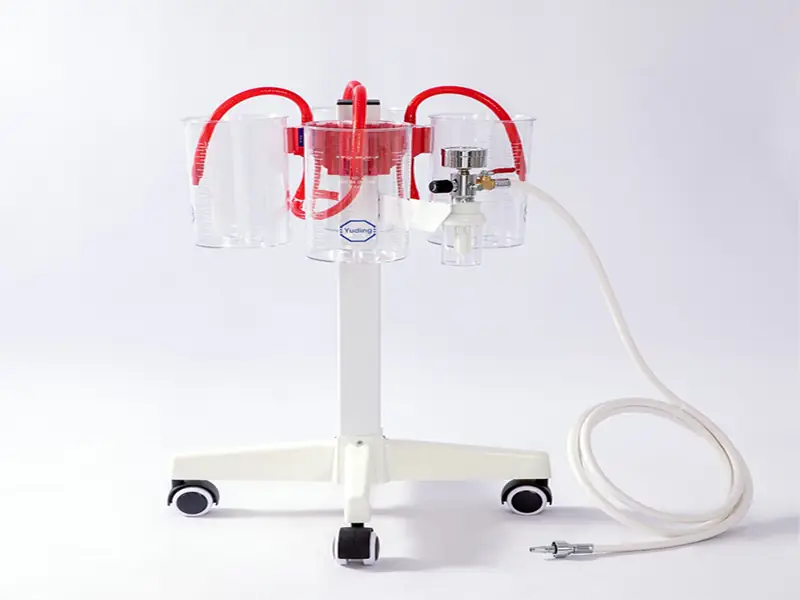
A mobile system brings the main collection and control components together on one stand. The available configurations differ in canister quantity and maximum capacity.
Product Specifications
| Specification | YDI | YDII | YDIII | YDIV |
| Trolley stand | 1 | 1 | 1 | 1 |
| Canister | 1 | 2 | 3 | 4 |
| Bracket | 1 | 2 | 3 | 4 |
| Regulator | 1 | 1 | 1 | 1 |
| Maximum capacity | 3.5 L | 7.0 L | 10.5 L | 14 L |
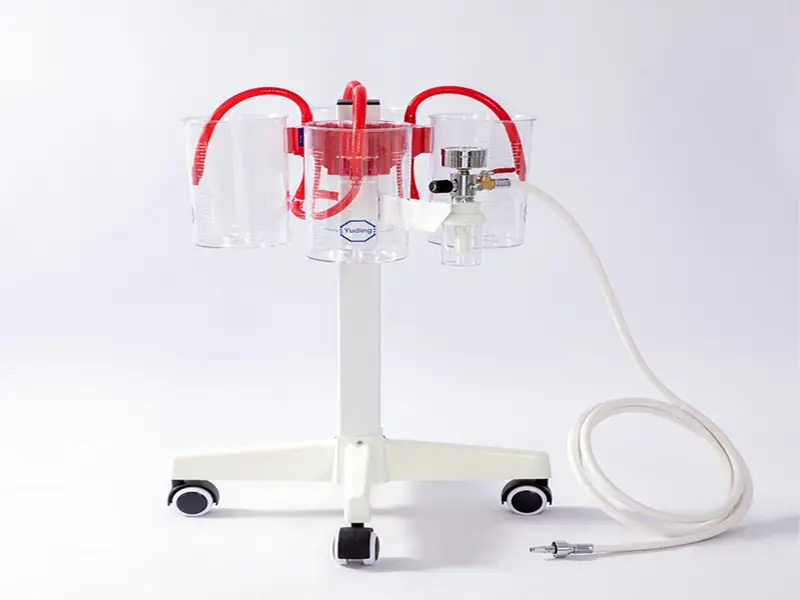
Four Configurations for Different Collection Volumes
The four configurations provide maximum capacities from 3.5 L to 14 L. YDI has one canister, while YDII, YDIII, and YDIV have two, three, and four canisters respectively.
This range allows buyers to compare total capacity with expected clinical workload. A lower-capacity configuration may be sufficient for limited collection needs, while a model with more canisters may suit applications requiring greater total capacity.
Available floor space and staff access should also be considered. Confirm the selected model’s dimensions before ordering.
Integrated Stand, Canisters, Brackets, and Regulator
Each configuration includes one trolley stand and one regulator. The bracket quantity corresponds to the number of canisters.
The stand supports the collection components, while the brackets hold the canisters in position. The regulator controls the applied vacuum within its specified operating range. Request its technical details and confirm that its connection suits the hospital vacuum source.
Disposable liners and other consumables should be checked separately. Treat them as included only when their models and quantities appear on the quotation.
Safety Bottle in the Negative-Pressure Pipeline
The trolley includes a safety bottle in the negative-pressure pipeline. It helps prevent waste fluid from reaching the central vacuum system, reducing the risk of damage to downstream equipment.
Ask the supplier to identify its position in the connection diagram and provide the applicable inspection or replacement instructions. Correct assembly and routine inspection remain necessary.
Silent Casters for Easier Movement
The trolley uses silent casters to support quieter movement in clinical areas. This is useful when staff need to reposition the equipment during patient care.
Before ordering, check the trolley dimensions against doorways, corridors, and storage space. Confirm the caster arrangement and whether locking features are available for the selected configuration.
Quick Assembly for Delivery and Preparation
The quick-assembly design is intended to simplify transportation and preparation after delivery.
Request assembly instructions and packed dimensions before shipment. For bulk orders, confirm packaging methods, spare-part availability, and after-sales support.
Frequently Asked Questions
What is the maximum capacity of the mobile trolley?
The largest listed configuration has four canisters and a maximum capacity of 14 L. The other configurations provide maximum capacities of 3.5 L, 7.0 L, and 10.5 L.
Does the trolley include a safety bottle?
The product configuration identifies a safety bottle in the negative-pressure pipeline. Confirm its inclusion, along with the required tubing and connectors, on the final quotation and packing list.
Are disposable liners included with the trolley?
The liner model and quantity should be confirmed separately in the quotation. Buyers should also check compatibility with the supplied canisters.
What is the difference between a disposable liner and a reusable canister?
The liner is the disposable inner container that receives collected fluid. The reusable canister supports the liner and connects to the vacuum line. Their dimensions and connection designs must be compatible.
Can the trolley connect to any hospital vacuum adapter?
Universal compatibility should not be assumed. The regulator, tubing, and outlet connection must match the facility’s vacuum source. Provide the supplier with the vacuum adapter specifications and request written confirmation.
Conclusion
A suitable collection system needs sufficient capacity, compatible connections, and dimensions that fit the hospital’s working space. Buyers should also consider how reusable parts will be maintained and how disposable liners and replacement components will be replenished.
A clear component list helps prevent missing parts at delivery. Confirmed connection details reduce installation uncertainty, while consistent component models simplify compatibility checks and inventory management during repeat purchases.
If you are sourcing a mobile suction liner trolley for your hospital or distribution business, provide the required collection capacity, preferred configuration, vacuum adapter specifications, intended clinical location, order quantity, and packaging requirements. Yuanding Medical can review your requirements, recommend a suitable configuration, and supply relevant technical documentation together with a formal quotation.